Heavy equipment maintenance presents a high-stakes reality for fleet managers and contractors. You constantly face the tension between reducing procurement costs and avoiding the catastrophic financial impact of equipment downtime. Premature part failure stops projects, idles crews, and destroys profit margins. Navigating the saturated Chinese manufacturing market adds another layer of complexity to this challenge. Procurement managers often struggle to distinguish between genuine, high-quality manufacturers and unreliable trading companies masking as direct factories. Finding the right manufacturing partner requires more than browsing online directories. It demands a systematic, evidence-based framework for vetting facilities and analyzing technical capabilities. You need to look past polished brochures to verify metallurgical standards and production capacity. We will break down exactly how to evaluate suppliers, dissect quotations, and establish secure, long-term sourcing relationships for critical heavy equipment components.
Key Takeaways
Supplier Typology: Distinguishing direct manufacturers from trading companies is the first critical step in controlling costs and ensuring consistent quality control.
Metallurgical Verification: For high-wear components, evaluating a supplier's in-house heat treatment and metallurgical testing capabilities is non-negotiable.
Quotation Analysis: A reliable heavy equipment parts quotation must transparently detail material grades, weight tolerances, warranty terms, and specific Incoterms, rather than just a bottom-line price.
Risk Mitigation: Implementing third-party factory audits, rigorous sample testing protocols, and structured payment terms prevents the common pitfall of "quality fade" in subsequent production runs.
The Landscape of Construction Machinery Parts Suppliers in China
Understanding the sourcing ecosystem in China dictates your procurement success. Many buyers make poor decisions because they lack regional and structural knowledge of the market. Without this context, you risk partnering with intermediaries who add unnecessary markups and dilute quality control. You must map out the supply chain before sending a single email.
Manufacturers vs. Trading Companies
The Chinese market consists of both direct factories and trading intermediaries. Each serves a distinct purpose. Confusing the two often derails procurement strategies. Direct manufacturers own their production equipment. They employ engineers and control the quality assurance process from raw material to finished product. Trading companies act as middlemen. They source products from various factories and handle the export logistics.
Working with a trading company makes sense when you need to consolidate small orders. If you require diverse construction machinery spare parts across different product categories, a trader simplifies the process. They manage multiple factory relationships so you do not have to. However, a direct manufacturer is strictly required for high-volume orders or custom-engineered components. Direct communication with the factory ensures technical specifications are met. It also eliminates the middleman markup.
You can identify a trading company by examining their product catalog. If a single company offers hydraulic pumps, rubber tracks, and cabin glass, they are a trader. No single factory manufactures all these disparate components. Always request a copy of their business license. Translate the business scope section. It must explicitly state "manufacturing" or "production" rather than just "sales" or "technology development."
Operational Feature
Direct Manufacturer
Trading Company
Production Control
High. Direct oversight of materials, machining, and heat treatment.
Low. Relies entirely on third-party factory standards.
Customization Capability
Excellent. Can modify molds, tooling, and metallurgy.
Limited. Usually offers standard off-the-shelf items.
Order Volume Requirements
Requires high Minimum Order Quantities (MOQ) to run production lines.
Flexible. Can accommodate smaller, mixed-container orders.
Technical Communication
Direct access to technical engineers and floor managers.
Relies on sales representatives acting as intermediaries.
Regional Manufacturing Hubs
China features highly specialized geographical manufacturing hubs. Knowing these regions helps you verify supplier claims immediately. If a supplier claims to manufacture a specific part but is located thousands of miles from the relevant industrial cluster, they are likely a trading company.
Quanzhou (Fujian): This region dominates the production of heavy equipment undercarriage parts. It houses extensive forging and heat-treatment facilities dedicated to rollers, idlers, and sprockets. The local supply chain supports rapid access to raw steel and specialized machining tools.
Ningbo (Zhejiang): Known globally for advanced casting technologies. This hub specializes in ground engaging tools, complex castings, and precision machining. Foundries here often utilize lost-wax or sand casting methods suitable for high-wear items.
Jining (Shandong): A major center for general earthmoving machinery components. It benefits from proximity to major OEM assembly plants. This proximity fosters a robust network of secondary parts suppliers producing pins, bushings, and structural weldments.
Core Evaluation Criteria for a China Construction Machinery Supplier
You must establish strict baseline requirements before shortlisting any facility. A reliable China construction machinery supplier must demonstrate operational excellence, technical expertise, and transparent communication. Do not rely on glossy website photos. Demand hard data.
Quality Assurance and Metallurgical Standards
Visual inspections cannot reveal the internal strength of a steel component. You must request raw material certificates for every batch. These documents, known as mill test reports, prove the steel grade originates from a reputable mill. They detail the exact chemical composition of the heat.
Evaluate the factory's in-house testing equipment. A serious manufacturer owns spectrometers to verify chemical composition before pouring or forging. They use hardness testers (Brinell or Rockwell scales) to confirm heat treatment success. They must employ ultrasonic flaw detectors to identify internal micro-cracks. These hidden defects cause catastrophic failure under heavy loads. Ask for calibration records for these testing machines. Uncalibrated equipment produces useless data.
Testing Equipment
Primary Function
Risk of Absence
Optical Emission Spectrometer
Verifies exact chemical composition of raw steel.
Incorrect alloy usage leading to premature part failure.
Rockwell/Brinell Hardness Tester
Measures surface and core hardness post-heat treatment.
Parts that are too soft (rapid wear) or too brittle (shattering).
Ultrasonic Flaw Detector
Scans internal structure for micro-cracks and voids.
Catastrophic structural failure under heavy operational loads.
Coordinate Measuring Machine (CMM)
Verifies exact dimensional tolerances against CAD drawings.
Parts failing to fit onto the machinery during installation.
Production Capacity and Scalability
Assessing a factory's true output capacity prevents supply chain bottlenecks. You need to know if they can meet peak-season demand. Ask for their monthly tonnage capacity and current utilization rates. If a factory operates at 95% capacity, they will likely subcontract your order to unvetted secondary workshops during busy periods.
Subcontracting destroys quality consistency. Ensure they have dedicated production lines. Check their raw material buffer stock. A factory holding substantial steel inventory can weather supply chain disruptions and maintain your delivery schedules. Request a video tour of their raw material yard to verify their claims.
Technical Communication and Engineering Support
Language barriers and technical misunderstandings cost money. Evaluate the supplier's ability to read and process complex technical drawings. They should easily handle formats like CAD, SolidWorks, or STEP files.
The English proficiency of their sales engineers dictates the success of the project. They must understand dimensional tolerances, surface finish requirements, and machining symbols. If the sales team cannot confidently discuss Rockwell hardness scales or tensile strength, you risk receiving parts that do not fit your machinery. Test their knowledge during the initial inquiry by asking specific questions about material yield strength or heat treatment cycles.
Certifications and Compliance
International certifications provide a baseline of operational competence. Look for ISO 9001 for quality management systems. Look for ISO 14001 for environmental management. Do not just accept a PDF certificate at face value.
Verify their authenticity directly through the issuing bodies. Check the scope of the certification. It should explicitly state "manufacturing of machinery parts" rather than just "sales and export." A valid ISO 9001 certificate indicates the factory follows documented procedures for non-conforming products and corrective actions.
Sourcing and Evaluating Specific High-Wear Components
Different parts require entirely different manufacturing disciplines. Break down your technical evaluation criteria based on the specific high-wear components you need. Expected wear-life benchmarks should guide your procurement decisions.
Evaluating Heavy Equipment Undercarriage Parts
Undercarriage systems endure massive stress and abrasive environments. When evaluating track rollers, carrier rollers, idlers, and sprockets, focus heavily on the internal components and heat treatment.
Bimetal bushings are mandatory for longevity. They provide superior friction resistance compared to standard bronze. The quality of the floating seal dictates whether dirt will breach the internal cavity and destroy the bearings. Ask the supplier about their seal suppliers. Reputable factories use established seal brands rather than generic alternatives.
Pay close attention to the depth of induction hardening on the wear surfaces. Shallow hardening leads to rapid wear once the initial millimeter of steel degrades. Request cross-sectional hardness profiles. You should establish baseline warranty expectations upfront. A quality undercarriage component should reliably deliver 2,000 to 3,000 working hours under standard operating conditions.
Assessing Excavator Track Chain Assemblies
Track chains hold the entire machine together while transferring power to the ground. The manufacturing requirements for track links and pins are incredibly stringent. Discuss the specific forging techniques used by the supplier. Precision die forging aligns the internal grain structure of the steel, maximizing strength.
The critical factor for excavator track chain assemblies is precise heat treatment. Proper quenching and tempering prevent chain elongation and pin breakage. If the tempering temperature fluctuates, the links become brittle and snap under impact. Demand documentation detailing their continuous heat treatment furnace controls. Ask about their pin and bushing press-fit tolerances. Loose tolerances lead to premature internal wear and track snaking.
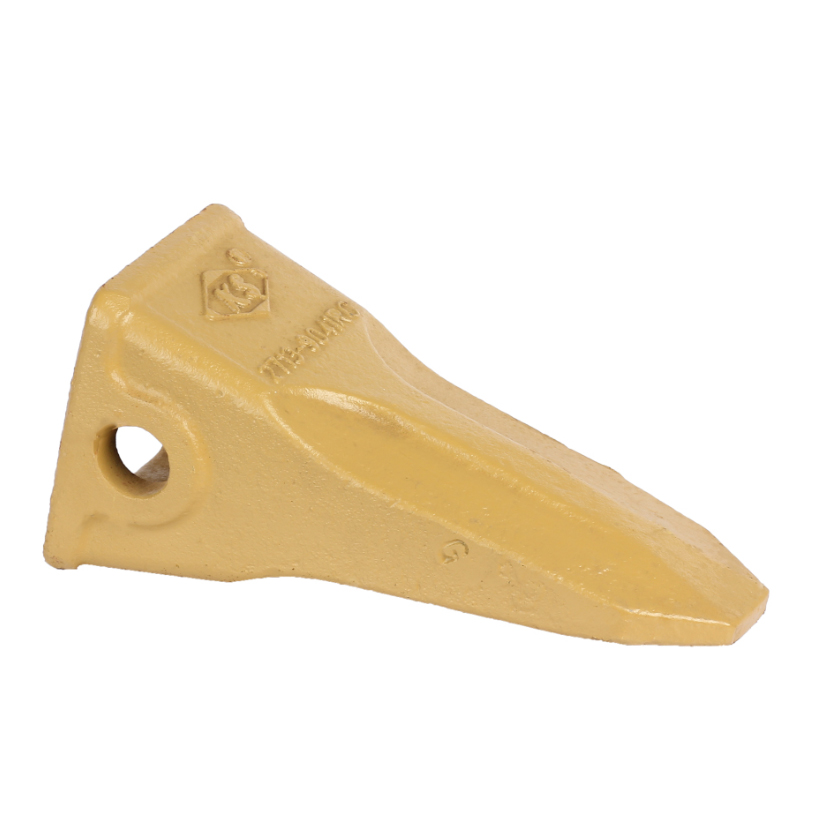
Inspecting Excavator Bucket Teeth and Adapters
Ground engaging tools dictate the digging efficiency of the machine. Understand the difference between casting and forging processes for these parts. Forging generally provides higher impact resistance. Casting allows for complex, self-sharpening profiles.
The alloy composition is the most vital element for excavator bucket teeth. Standard carbon steel wears out rapidly in rocky terrain. Highlight the necessity of specific alloys, such as boron steel or high-carbon alloy steel. These materials achieve the optimal balance between impact toughness and abrasion resistance. Impact toughness prevents snapping against rocks. Abrasion resistance prevents rapid wear in sandy soil. Request Charpy V-notch impact test results to verify the steel's toughness at low temperatures.
How to Request and Analyze a Heavy Equipment Parts Quotation
Moving beyond the unit price is mandatory for risk management. You must evaluate the complete landed cost and identify hidden risks in poorly structured quotes. A low initial price often masks severe quality compromises.
Essential Elements of a Comprehensive RFQ
A bulletproof Request for Quotation (RFQ) eliminates ambiguity. Vague requests yield inaccurate pricing. Your RFQ must include specific details to force the supplier to commit to a standard.
Exact OEM part numbers and corresponding machine models.
Required material grades and specific heat treatment hardness ranges.
Dimensional tolerances and acceptable variance limits.
Expected order volumes and delivery timelines.
Specific packaging requirements for ocean freight.
Testing and inspection requirements prior to shipment.
Red Flags in Pricing and "Quality Fade"
Beware of the "too good to be true" price trap. Steel is a global commodity with relatively stable pricing. If a quote comes in 30% below the market average, the supplier is cutting corners.
They might substitute lower-grade steel. They might reduce the physical weight of the part by altering the casting mold. They might skip crucial heat treatment cycles to save on electricity costs. You need a transparent heavy equipment parts quotation that breaks down material costs, machining labor, and profit margins. If a supplier refuses to provide the unit weight of a cast part, they are likely planning to hollow out the design to save material.
Incoterms, Tariffs, and Hidden Logistics Costs
Understand how shipping terms impact your final landed cost. FOB (Free on Board) means the supplier covers costs to the departure port. EXW (Ex Works) places all transport costs and risks on you from the factory door. CIF (Cost, Insurance, and Freight) includes ocean shipping, but often hides inflated local port charges upon arrival.
Incoterm
Supplier Responsibility
Buyer Responsibility
Risk Level for Buyer
EXW (Ex Works)
Manufacture and package goods at the factory.
All transport, export clearance, and ocean freight.
High. Requires strong local logistics partners in China.
FOB (Free on Board)
Transport to port and clear export customs.
Ocean freight, insurance, and import clearance.
Low. Standard industry practice for maximum control.
CIF (Cost, Insurance, Freight)
Transport to destination port, including insurance.
Import clearance and final delivery to warehouse.
Medium. Often results in hidden destination port fees.
Discuss packaging requirements thoroughly. Heavy parts require fumigated wooden pallets or custom steel crates to survive ocean transit. Flimsy packaging leads to rusted or damaged parts upon arrival. Clarify who bears the cost of export customs clearance. Address the impact of HS codes. Incorrect classification leads to severe import duties or unexpected anti-dumping tariffs on Chinese steel components at your destination port. Work with a licensed customs broker to verify the correct HS codes before placing the order.
Implementation Risks and Mitigation Strategies
Signing a contract is only the beginning. You must address operational realities, financial security, and potential points of failure that arise during mass production.
Financial Stability and Secure Payment Terms
Never agree to 100% upfront payments. Standard industry practice involves a 30% T/T (Telegraphic Transfer) deposit to initiate production. The remaining 70% is paid against the copy of the Bill of Lading (B/L) after the goods ship.
This structure keeps the supplier motivated to finish the order on time. For large-volume orders, utilize Letters of Credit (L/C) to provide bank-backed security for both parties. An L/C ensures the supplier only gets paid when they present compliant shipping documents to the bank. It protects your capital if the supplier fails to ship the goods.
Rigorous Sample Testing Protocols
Always order paid samples before authorizing mass production. Treat the sample as a strict qualification test. Conduct fitment tests on actual machinery to verify dimensional accuracy.
Send the sample to an independent domestic lab for destructive and non-destructive testing. This verifies the supplier's metallurgical claims. It ensures the steel grade matches the paperwork. Test the core hardness versus the surface hardness. If the core is too soft, the part will crush under pressure. If the core is too hard, the part will shatter.
Mitigating "Quality Fade" Over Time
Quality fade occurs when a supplier gradually degrades product quality over successive orders to increase their profit margins. They might shorten heat treatment times or switch to cheaper raw materials after the third or fourth shipment.
Establish strict protocols for continuous batch testing. Implement random inspections. Make it clear that any deviation from the approved sample will result in rejected shipments. Require the supplier to send production photos and material certificates for every single batch before you authorize the final balance payment.
Intellectual Property and Proprietary Molds
If you are ordering custom aftermarket parts, protect your proprietary designs. Standard Non-Disclosure Agreements (NDAs) are often useless overseas.
You need a localized Non-Disclosure, Non-Use, and Non-Circumvention (NNN) agreement. This document must be drafted in Chinese and explicitly enforceable in Chinese courts. It prevents the factory from selling your custom molds to your competitors. Register your trademarks in China, even if you do not plan to sell products there. This prevents the factory from trademarking your brand and holding your products hostage at customs.
Third-Party Inspections and Factory Audits
Do not rely solely on supplier-provided photos. Use independent inspection agencies like SGS or TÜV for Pre-Shipment Inspections (PSI).
They will verify quantities, check packaging, and perform random dimensional checks before the container is sealed. Commission an initial factory audit to verify the physical machinery. Assess labor conditions and confirm actual production capabilities match their claims. An auditor will check the factory's electricity bills to confirm they are actually running production lines, rather than just acting as a front for a trading company.
Conclusion
Finalize your comprehensive RFQ documentation with exact material and dimensional specifications.
Initiate the vetting process by ordering a paid sample batch for independent domestic metallurgical testing.
Draft a secure payment structure and establish clear warranty terms before issuing the final Purchase Order.
FAQ
Q: How can I verify if a China construction machinery supplier is a factory or a trading company?
A: Check their business license for the specific manufacturing scope. Request a live video tour of the production floor to see the equipment running. Look for ISO certificates registered specifically for manufacturing operations, not just sales or export activities. Cross-reference their location with known industrial manufacturing hubs.
Q: What is the standard lead time for heavy equipment undercarriage parts from China?
A: Expect 30 to 45 days for actual production. Add another 20 to 40 days for ocean freight, depending on your destination port. Custom-forged items or parts requiring new molds will extend this timeline significantly. Always factor in potential customs clearance delays when planning your inventory cycles.
Q: Why do excavator bucket teeth from different suppliers wear out at drastically different rates?
A: Wear rates depend entirely on the alloy composition and the specific heat treatment process. Cheaper teeth lack the proper balance of hardness and impact toughness. This imbalance leads to rapid abrasion in sandy soil or snapping under heavy loads in rocky terrain.
Q: What should be included in a standard heavy equipment parts quotation?
A: A professional quote must include the unit price, exact material specifications, weight per piece, clear warranty terms, minimum order quantity, production lead time, packaging details, and specific Incoterms. Refuse any quote that only provides a bottom-line price without detailing the material grade and unit weight.
Q: Is it safe to buy excavator track chain assemblies through online wholesale platforms?
A: Platforms work well for initial discovery, but transactions for high-value assemblies should never occur blindly. Only proceed after conducting independent factory audits, establishing direct engineering communication, and performing rigorous sample testing to ensure steel quality and dimensional accuracy.
Q: How do I handle warranty claims for defective construction machinery spare parts from overseas?
A: Negotiate warranty terms before issuing the purchase order. Standard practice involves the supplier providing free replacement parts in the next shipment. You must provide clear photographic and technical evidence of the defect, measured against standard operating hours and baseline performance metrics.